
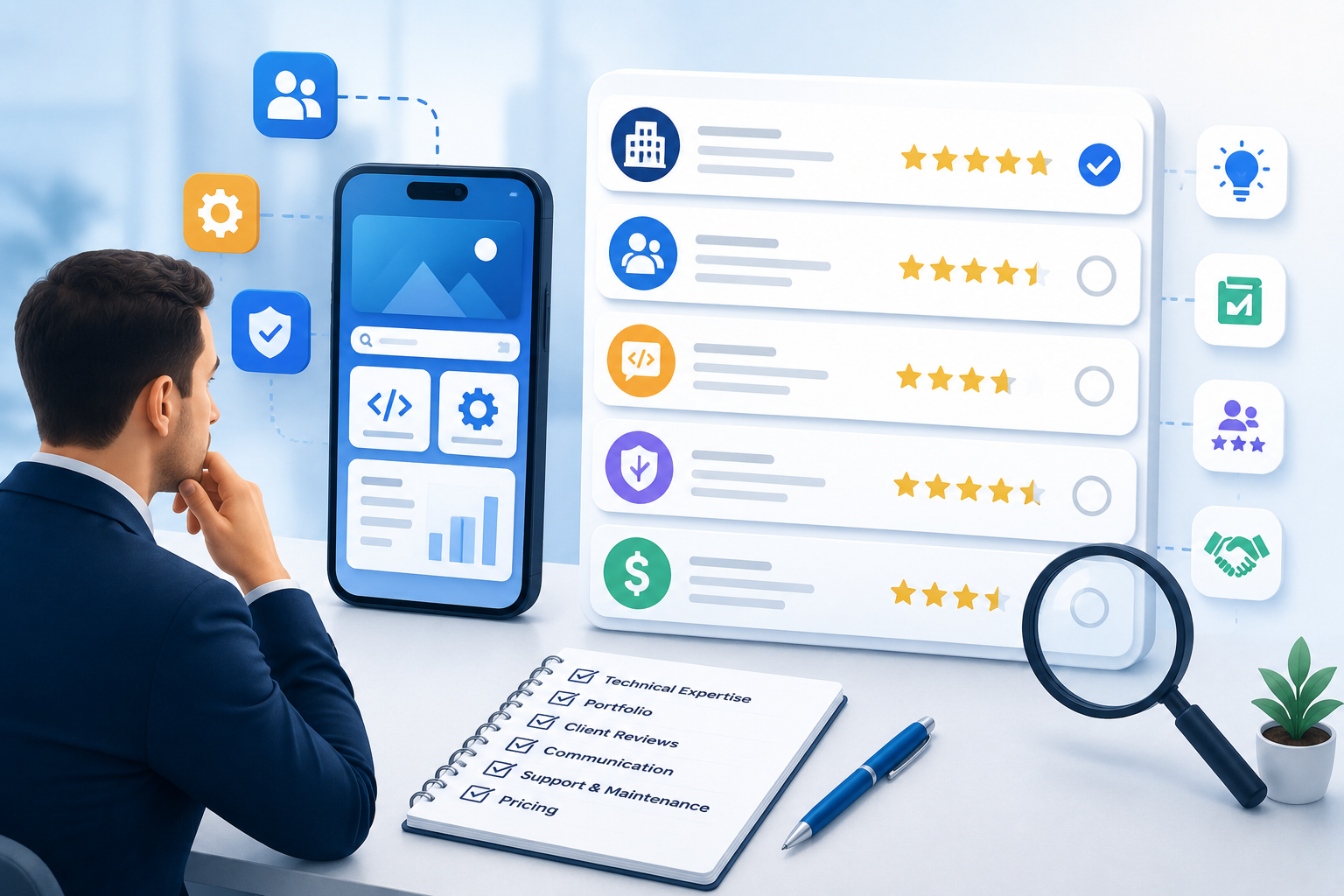
Choosing the right partner for mobile app development is one of the most important decisions you’ll make during your digital product journey. A proposal may look impressive on paper, with competitive pricing, attractive timelines, and a polished portfolio. But the real question is whether that team can build, launch, and support an application that performs reliably as your business grows. That decision will have a lasting impact on your product’s success.
The stakes are higher than ever. The global mobile app development market is expected to exceed $626 billion by 2030, driven by AI-powered experiences, cloud-native architectures, and increasingly complex integrations. As user expectations continue to rise, building an app is no longer the biggest challenge. Creating a secure, scalable, high-performing application that adapts to future business needs is what separates successful products from costly failures.
Many businesses make the mistake of selecting a mobile app development company based primarily on the lowest price. While an inexpensive proposal may reduce upfront costs, it can lead to poor code quality, missed deadlines, security vulnerabilities, expensive rework, and limited scalability. In many cases, fixing or rebuilding an underperforming app costs significantly more than investing in the right development partner from the beginning.
That’s why understanding how to choose the best mobile app development company goes far beyond comparing portfolios or hourly rates. You need a partner that understands your business objectives, follows proven development processes, prioritizes security and performance, communicates transparently, and can support your product long after launch.
In this guide, you’ll learn how to evaluate a mobile app development company beyond marketing claims. We’ll cover the essential evaluation criteria, warning signs to avoid, key questions to ask before signing a contract, pricing models, technical capabilities, post-launch support, and the factors that distinguish a reliable long-term technology partner from a short-term vendor. By the end, you’ll have a practical framework for choosing a mobile app development partner that delivers lasting business value rather than just an app.
Types of Mobile App Development Partners
Not every mobile app development provider offers the same level of expertise, resources, or long-term support. Understanding the different types of development partners will help you choose one that matches your project scope, budget, and business goals.
1. Enterprise Mobile App Development Companies
Enterprise development firms are large agencies with dedicated teams of business analysts, UI/UX designers, mobile developers, QA engineers, DevOps specialists, project managers, and security experts. They follow structured development processes and can handle complex applications that require integrations, compliance, scalability, and ongoing maintenance.
Best for:
- Large businesses and enterprises
- Complex mobile applications
- Regulated industries (healthcare, finance, logistics)
- Long-term digital transformation projects
Pros
- End-to-end development services
- Strong quality assurance processes
- High security and compliance standards
- Reliable post-launch support
- Ability to scale development teams
Cons
- Higher development costs
- Longer procurement and onboarding process
2. Mid-Sized Mobile App Development Agencies
Mid-sized agencies combine experienced multidisciplinary teams with greater flexibility than enterprise firms. They typically offer strategy, UI/UX design, development, testing, deployment, and maintenance while maintaining competitive pricing and faster communication.
For many startups and growing businesses, this category offers the best balance between quality, cost, and speed.
Best for:
- Startups
- SMBs
- Growing enterprises
- MVPs and production-ready apps
Pros
- Good balance of expertise and affordability
- Faster communication
- Flexible engagement models
- Strong technical capabilities
Cons
- Smaller resource pool than enterprise firms
- May not support extremely large-scale projects
3. Boutique App Development Studios
Boutique studios are small, highly specialized teams that focus on delivering premium, design-driven, or niche applications. Many have deep expertise in a particular technology, platform, or industry.
Their smaller size often means more direct collaboration with senior developers and designers.
Best for:
- Design-focused products
- Industry-specific applications
- Companies seeking personalized collaboration
Pros
- Highly specialized expertise
- Direct access to senior talent
- Strong attention to detail
- Personalized communication
Cons
- Limited development capacity
- May struggle with multiple large concurrent projects
- Smaller support teams
4. Freelance Mobile App Developers
Freelancers are independent professionals who usually specialize in development, design, or a specific technology stack. While hiring freelancers can reduce initial costs, managing an entire app project often requires coordinating multiple specialists, including designers, developers, QA testers, and DevOps engineers.
Freelancers can be a good fit for small tasks or MVPs, but they introduce greater project management and continuity risks for business-critical applications.
Best for:
- Small projects
- MVP validation
- Bug fixes
- Feature enhancements
Pros
- Lowest upfront cost
- Flexible hiring
- Fast availability
Cons
- Limited resources
- Higher dependency on one individual
- Less predictable timelines
- Limited long-term support
- Greater project and communication risks
Which Type Is Right for You?
There isn’t a one-size-fits-all answer. The right mobile app development partner depends on your product complexity, budget, timeline, and long-term business objectives. Enterprise firms are ideal for large, mission-critical platforms, while boutique studios excel at specialized solutions. Mid-sized agencies often provide the best balance of quality, expertise, and cost, making them an excellent choice for most businesses. Freelancers are best suited for smaller projects rather than full-scale commercial applications that require ongoing support and continuous improvements.
How to Choose a Best Mobile App Development Company: Proven Tips
This is where things get real. Once you move past proposals, the difference between vendors shows up in how they think, not what they say. In mobile app development, that gap becomes obvious pretty quickly. For teams, these areas usually determine whether your product scales cleanly or starts creating friction within months.
- Product Thinking vs Feature Execution
- Evaluate Portfolio Depth, Not Just Visual Quality
- Assess UX Beyond Visual Design
- System Architecture and Scalability Readiness
- Data Flow, Integrations, and Reliability
- Engineering Execution and Communication Discipline
- Team Structure, Ownership, and Collaboration
- Scalability Across Teams and Systems
- Validate Through Client References and Market Reputation
- Security and Intellectual Property Protection
- Pricing Transparency and Cost Clarity
- Post-Launch Support and Product Evolution
1. Product Thinking vs Feature Execution
You’ll feel this in the first real conversation. Some teams take your requirements and move straight to timelines. Others pause and try to understand what you’re actually trying to solve.
The better ones will:
- Break features into real user journeys tied to outcomes
- Point out gaps or unnecessary features early
- Connect everything back to business goals, not just delivery
Instead of agreeing to build a dashboard, they’ll ask who uses it and what decisions depend on it. That kind of thinking saves time later.
2. Evaluate Portfolio Depth, Not Just Visual Quality
Most portfolios look good at a glance. That’s not enough. Look a little closer:
- Have they handled complex systems or just simple apps?
- Are those apps still active or just one-time builds?
- Do they have experience in problems similar to yours?
- Were they involved in planning, or just execution?
You’re not just checking design. You’re trying to understand how their work holds up over time.
3. Assess UX Beyond Visual Design
A clean interface is expected. What matters is how easy it feels to use.
Check things like:
- Can users complete tasks without getting stuck?
- Do workflows feel natural, even when they’re complex?
- Do they test and refine based on real usage?
In many cases, UX issues don’t show up early. They show up later as drop-offs or low engagement.
4. System Architecture and Scalability Readiness
Most systems don’t fail at launch. They struggle when new capabilities need to be added.
In mobile app development today, scalability is less about handling more users and more about functional scalability.
Ask sharper questions:
- Can new features be added without impacting existing modules?
- Is the frontend modular or tightly coupled?
- Can AI-driven features be introduced without reworking the system?
Strong teams design with decoupled architecture and serverless orchestration. If that’s missing early on, the system tends to become restrictive much faster than expected.
5. Data Flow, Integrations, and Reliability
This is where things quietly start breaking if not planned well.
Look at how they handle:
- Data moving between systems
- Integrations with APIs, payments gateways, or internal tools
- Delays or failures in real scenarios
- Keeping data consistent across the app
Think of simple cases. A payment fails or an API slows down. If that’s not handled properly, users feel it right away.
6. Engineering Execution and Communication Discipline
This is where plans either hold up or start slipping. You’ll usually get a sense of this after a couple of calls or a sample sprint plan.
What to watch for:
- Do they work in clear sprints with defined outputs?
- Are updates structured or scattered across messages and calls?
- Do they explain delays and trade-offs clearly?
You don’t need constant updates. You need clarity on what’s done, what’s next, and what’s at risk. That’s what keeps things moving without confusion.
7. Team Structure, Ownership, and Collaboration
This often gets overlooked early, but it shows up quickly once work starts.
Try to understand:
- Who is actually working on your project day to day
- Whether there’s a clear technical owner making decisions
- How work is divided across frontend, backend, and integrations
Also, think about team collaboration. Will your team be involved in reviews and decisions, or just get updates? The smoother this works, the fewer bottlenecks you’ll hit.
8. Scalability Across Teams and Systems
Things usually feel fine at the start. Then new features, markets, or teams come in, and everything starts slowing down.
Look at both sides:
- Team side:
- Can they add people without disrupting progress?
- Can multiple teams work together without stepping on each other’s work?
- System side:
- Can new features be added without affecting existing ones?
- Will it handle more users, data, and integrations without strain?
Think ahead a bit. If you expand to a new region or add a major feature, does it fit into what’s already built or require rework? That answer says a lot.
9. Validate Through Client References and Market Reputation
This is where things get more real. Anyone can put testimonials on a website, but actual client experience tells a different story.
Go beyond what’s shown:
- Ask for real client references, not just case studies
- Check platforms like Clutch to see consistent feedback
- Look for patterns around delivery, communication, and support
- Try to understand how they handled challenges or delays
You’re not just verifying claims here. You’re trying to see how they perform when things don’t go as planned.
10. Security and Intellectual Property Protection
This doesn’t always come up early, but it should. Especially if your app deals with user data or transactions.
You don’t need deep technical details, just clarity:
- How do they handle data security and access?
- Are they familiar with compliance needs in your space?
- Do they follow secure mobile app development practices?
- Are they comfortable with NDAs and IP protection?
If this feels vague, it usually becomes a concern later.
11. Pricing Transparency and Cost Clarity
This is where things often look simple at first and get complicated later.
Try to understand:
- Is the pricing broken down clearly or just a total number?
- How do they handle scope changes?
- Are third-party costs discussed upfront?
- What happens to costs post-launch?
A transparent team will walk you through how app development costs might change, not just what they are today.
12. Post-Launch Support and Product Evolution
What happens after launch matters more? This is where many partnerships fall apart. The app goes live, and suddenly support slows down or ownership becomes unclear.
A strong partner will:
- Offer structured post-launch support, not ad hoc fixes
- Monitor performance and resolve issues proactively
- Plan for continuous improvements based on real usage
- Support scaling, upgrades, and new feature rollouts
Think beyond launch day. Your product will evolve, and you need a team that stays aligned as things grow.
Also Read: MVP to Enterprise Scaling Framework
Think a step ahead. Expanding into a new market or adding a major capability shouldn’t force you back into rework. It should slot into your existing setup without slowing everything down.
Key Factors to Evaluate a Mobile App Development Company
This is the stage where you cut through the noise. You’re not deep into comparisons yet, just figuring out which teams are worth your time. If you’re thinking about how to choose a mobile app development company, this step helps you filter out options that won’t hold up once things get real.
1. System Design and Scalability Readiness
Don’t get stuck on tech stacks. What matters is how the system is put together and whether it can handle growth without slowing everything down. When you hire mobile app developers, this is where the real difference shows up.
Good teams think ahead. They design in a way that lets you add key features of mobile app or scale users without reworking the entire system. If the setup feels rigid, it usually becomes a problem sooner than expected.
2. Integration and API Capability
Your app will connect with other systems, payments, CRMs, internal tools. That’s normal. The question is how well that’s handled.
If you’re trying to choose an app development agency, look at how they deal with real situations. What happens when an API fails? Or slows down? Strong teams plan for that upfront so it doesn’t impact your users.
3. Data Handling and Reliability
This is where small gaps turn into big issues. Data needs to move cleanly across systems and stay consistent.
When you choose a mobile app developer, check if they’ve thought this through. Can the system handle real-time updates and background processes without breaking things? If not, you’ll start seeing mismatches and delays pretty quickly.
4. User Experience Aligned to Business Goals
A good-looking app is not enough. It should feel easy to use, especially when workflows get complex.
The right team focuses on how users actually move through the product. That’s often the difference between something people use once and something they keep coming back to.
5. Security and Compliance Readiness
Security doesn’t usually show up early, but when it does, it’s hard to fix quickly. If you’re figuring out how to find the best app development company, this is something to check upfront. A reliable team builds with security in mind from day one and understands what your industry requires.
At this point, you’re not making the final call. You’re just narrowing it down to teams that won’t create problems later.
Why the Right Development Partner Matters
This decision shows up in your roadmap faster than expected. It’s not just about getting an app live. It’s about how much friction you carry into every release after that.
- Delivery speed vs delivery churn: A strong partner moves in steady, usable increments. A weak one ships fast early, then slows down with rework, missed edge cases, and unstable releases.
- Total cost vs quoted cost: The initial quote is rarely the real number. Gaps in app architecture or planning turn into change requests, fixes, and extended timelines. That’s where budgets start drifting.
- Scaling without disruption: As usage grows or new features come in, the system either adapts or starts pushing back. Poor early decisions show up as performance issues, integration breaks, or delayed rollouts.
- Operational load on your team: The wrong partner doesn’t just affect delivery. It pulls your internal team into constant clarifications, fixes, and coordination. That slows everything else down.
- Long-term flexibility vs lock-in: If the system isn’t built cleanly, even small changes become hard. You end up working around limitations instead of moving forward.
This isn’t just about who builds your app. It’s about how efficiently your product runs, scales, and evolves once real usage begins.
Top tips to consider before hiring a mobile app development company
Assess their expertise:
Take the time to research a company’s track record, review its work, and speak to its staff. Grill them with tough questions to get the best idea of their knowledge.
Availability in your time zone:
It is important to know whether your preferred web development company has available staff to communicate.
Understand the technology stack:
Be sure to ask what technologies your prospective mobile application development partner uses when creating apps. This will indicate how effectively they deliver quality solutions within a given timeline and budget.
Ask for detailed quotes:
Make sure that all quotes received from potential companies include a breakdown of costs associated with each stage of the project, including design, coding, testing, and deployment. This will help determine which companies can deliver value within your budget before signing up or paying anything upfront.
Request a timeline for completion:
You should request the expected delivery timelines from prospective app development companies. This ensures that every team member understands expectations upfront to prevent delays. Such an approach negates the chances of miscommunications or lack thereof when tasks are interdependent.
Discuss post-launch support plans:
If needed, ask if an ongoing maintenance plan is available after launch so you can anticipate the support offered after launching an app. For instance, resources should be readily available if problems arise or your app needs an update.
Know maintenance fees & best practices:
When hiring, check for additional charges related to maintenance, such as bug fixes, security patching, etc., as well as best practices like testing cycles, etc. All such aspects can impact overall cost projections significantly depending on size, usage patterns, complexity, and anticipated traffic.
Evaluate third-party integrations & platforms:
Inquire about any 3rd party integration’s required for backend systems/data storage, analytics tools, cloud hosting environments, payment gateways, etc. Such things may incur extra costs depending on the provider chosen, but these can drastically improve user experience.
Streamlined communication:
Ensure a clear line of communication between your point of contact and the vendor’s staff. Ideally, it is best to set response times, and frequency of meetings and get into virtual scrums. Keep regular updates going both ways between developer & client throughout the duration of the job to keep everyone informed.
How Softxmind Supports Enterprise Mobile App Development
When you’re evaluating a mobile app development company, the real question is simple.
Can they take ownership from idea to scale without creating friction between stages?
At Softxmind, the focus stays on continuity. Strategy, design, development, and scaling are handled as one flow. That’s what helps enterprise teams move faster without losing control. That approach is backed by scale, 2000+ applications delivered, an average MVP turnaround of 3 weeks, and 100M+ app downloads achieved globally across client products.
What this shows in practice is consistency. Not just in building apps, but in handling complexity across systems, users, and industries.
If you’re working through how to choose the best mobile app development company, this is the layer that often makes the difference. Not just who can build, but who can scale with you.
Want to move forward with clarity? Take a closer look at your architecture, timelines, and product roadmap with a team that’s delivered at scale.
Frequently Asked Questions about mobile app development
Question. How do you choose the right mobile app development agency for your business?
Ans. Most teams start with portfolios, but that only tells part of the story. What matters more is how the team thinks when you start discussing your product. Do they ask sharp questions or just agree with everything?
When you’re figuring out how to choose a mobile app development company, pay attention to how they approach your goals, not just your features. That usually tells you how things will go later.
Question. What are the essential traits of a top mobile app development company?
Ans. You’ll notice good teams pretty quickly. They don’t rush into building, they take a moment to understand what you’re trying to solve. They explain things clearly, think ahead, and don’t overcomplicate decisions.
When you’re choosing the right mobile app development company, this kind of clarity matters more than the tools they use.
Question. What should you consider before choosing an app development company?
Ans. Before you decide, take a step back and look at your side as well. How clear are your requirements? How complex is the product? How much can your team stay involved? When you think through these things early, it becomes much easier to choose a mobile app developer who actually fits your needs and doesn’t slow things down later.
Question. How do you find an app developer online?
Ans. Start with platforms where real work is visible, not just claims. Look at portfolios to see what they’ve actually built and whether it matches your needs. Check reviews on trusted sites like Clutch to understand client experiences.
Also, pay attention to how they price their work, how they handle support after launch, and whether they’re open to signing an NDA. These small details tell you how reliable they’ll be once the project starts.
Question. What factors do businesses consider most when choosing a mobile app development company?
Ans. Businesses primarily evaluate mobile app developers on their proven technical expertise, UI/UX design capabilities, and post-launch support. The final decision hinges on balancing upfront development costs with the long-term scalability and security of the application.
Key factors businesses prioritize include:
- Portfolio & Industry Experience
- Technical Proficiency & Architecture
- UI/UX Design Standards
- Project Management & Communication
- Pricing & Engagement Models
- Security & Compliance
- Post-Launch Maintenance
- Code Ownership
Question. How do founders choose the right mobile app development company for an enterprise-level application?
Ans. Founders select an enterprise app development partner by prioritizing security, scalability, and integration capabilities rather than just baseline coding skills. They evaluate vendors based on structured discovery phases, past experience with regulatory compliance (e.g., HIPAA, GDPR), and a clear track record of handling high-transaction volumes.
Key steps:
- Evaluate Enterprise Architecture & Technical Depth
- Scrutinize Security and Compliance
- Review Past Case Studies Over Portfolios
- Plan for Post-Launch Support and IP Rights