
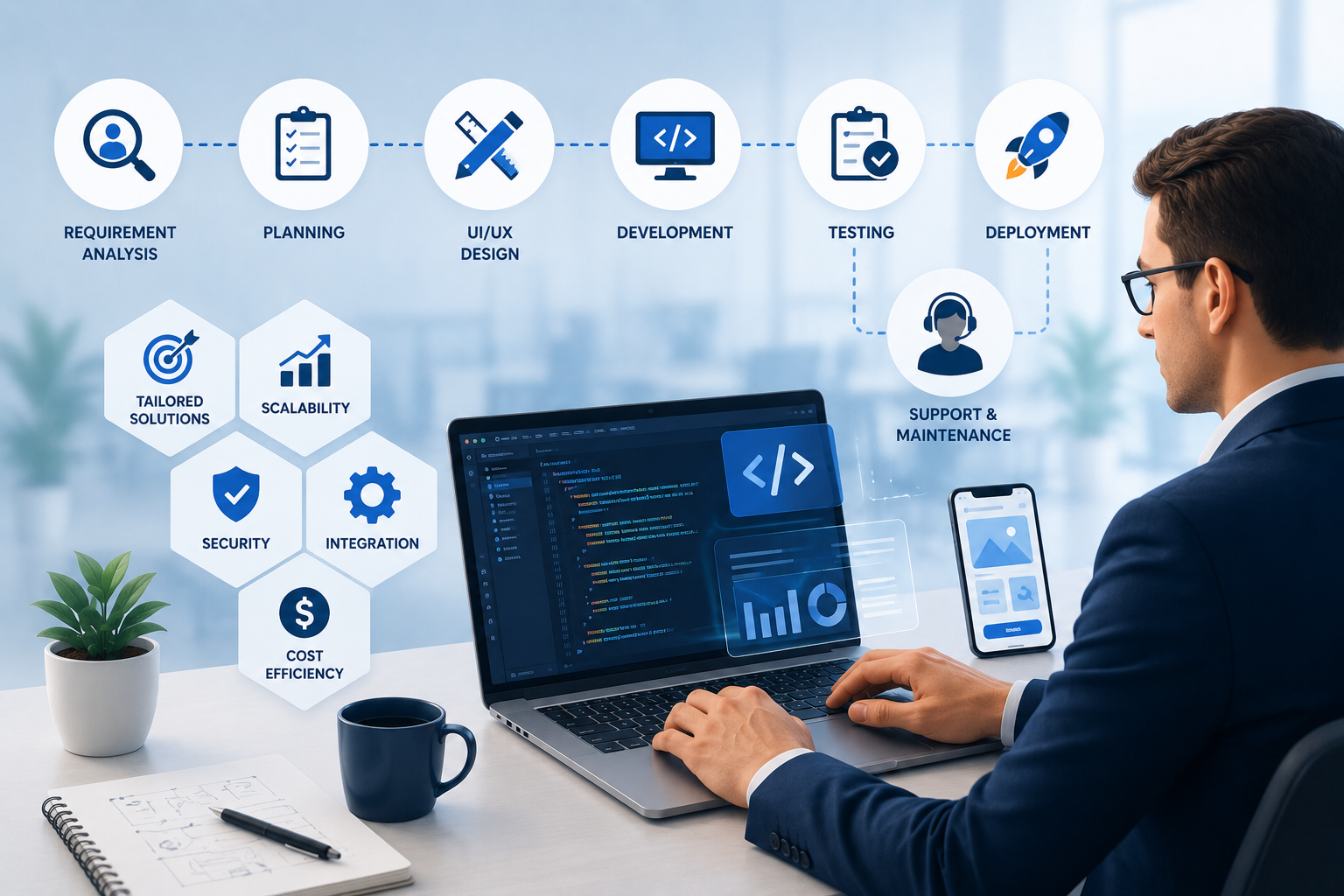
The global software development services market is valued at over $0.55 trillion and is expanding at an 11.8% CAGR. Driven by rapid cloud adoption and AI-Augmented coding, this rapid growth reflects a shift from off-the-shelf software to custom enterprise applications.
Software development services market overview:
- Current market size – it is valued at approximately $555 billion, and it is expanding at double-digit rates as businesses modernize legacy systems.
- AI transformation – development teams are shifting toward AI-augmented workflows. Generative AI code assistants are increasing developer productivity pushing engineers to focus on system design over routine boilerplate tasks.
- Cloud adoption – Cloud computing represents over 70% of deployments, bringing scalability and integrated DevOps.
Companies looking for external engineering support face a fragmented and confusing market. If you’ve outsourced before, you already know the gap between promises and delivery. Much of that gap comes down to fit, i.e., choosing the right model before you start shortlisting vendors.
Choosing the model depends on what you’re building and whether you already have engineering capacity. Some providers add developers to your existing team, while others deliver projects end-to-end. Some offer ongoing capacity, others fixed-scope builds. You can hire locally, offshore, or look for off-the-shelf software that will meet most of your needs.
What Kind of Software Development Services Do You Actually Need?
Let’s assume you’re in charge of a medium-sized business looking to invest in software development services to update its legacy systems or develop new client-facing solutions. You have to get it done without overspending or sacrificing quality. How do you choose the best approach?
The question is what kind of help to bring in. These three questions will help you get there.
Does the company already have a strong development team?
If the answer is yes, the answer is usually staff augmentation services. You don’t need to reinvent the wheel; you just need to add software developers to your in-house team to ship faster. Staff augmentation is a straightforward solution, provided your existing team is good.
But what if it’s not? What if your organization relies on a skeleton team that barely keeps your old PHP monolith operational? Adding people to a team that can’t absorb them usually creates more problems. In that case, you’ll need to look for a different model.
Is cost reduction the primary driver?
You’ve picked a model. Now the question is where the talent comes from, and that’s usually where budget enters the picture.
If cost is the main driver, offshoring becomes a tempting choice. Alternatively, you can decide to forgo some of the savings and choose local talent, or at least talent in your time zone. In that case, nearshoring tends to offer competitive pricing with time zone overlap and higher-caliber talent compared to most offshore shops.
If quality and speed outweigh cost considerations, companies can choose the best vendor regardless of location. The decision has nothing to do with geography, it’s all about quality and capability. However, few companies can afford the most expensive vendors out there, limiting their options.
What Are Software Development Services?
Software development services encompass the end-to-end activities required to design, build, deploy and maintain custom applications, systems or platforms. These services cover the entire software development life cycle. It include requirements gathering, UX/UI design, coding, rigorous quality assurance testing, cloud migration and continues maintenance.
Types of Software Development Services
These categories overlap, and not every provider covers all of them. Before you talk to vendors, it helps to know how services are categorized.
- Custom software development – Developing software from scratch to fit specific business requirements. This makes sense when off-the-shelf tools can’t handle your workflows, or when the software itself is your product or competitive edge.
- Enterprise software development – Large-scale systems for complex organizations: ERP, CRM, data platforms, integrations. These projects involve multiple stakeholders, compliance requirements, and usually need to work alongside legacy infrastructure.
- Software product development – Taking a market-facing SaaS or digital product from concept to launch. Providers typically handle product strategy, UX, development, and iteration.
- Mobile application development – Native iOS, Android, or cross-platform apps. Covers design, development, testing, and app store deployment.
- Web application development – Front-end, back-end, or full-stack work for web-based products. Can range from marketing sites to complex platforms with user accounts, payments, and integrations.
- API development and integration – Connecting systems via APIs, third-party integrations, or microservices. You need this when your software has to talk to other tools, platforms, or data sources.
- Cloud and DevOps services – This includes infrastructure design, continuous integration and continuous delivery (CI/CD), cloud migration, Kubernetes, monitoring, and so on. The focus is on software delivery, deployment reliability, scalability, and engineering speed.
- Data engineering and analytics – Data pipelines, warehouses, BI dashboards, ML model deployment. Relevant if you’re collecting large volumes of data and need to actually use it.
- QA and testing services – Automated and manual testing, performance testing, security audits. Sometimes standalone, sometimes bundled with development.
Most providers offer these services in combination. A custom software project will typically include architecture, development, QA, DevOps, and ongoing support bundled together. When evaluating vendors, consider the full range of what they can deliver rather than picking services à la carte.
Custom Software Development Services
So why does the industry refer to custom software development as a distinct category? It’s one thing to customize or fork existing solutions, but custom software in the context of providing development services means software is designed, built, and ultimately deployed to meet specific user needs. All the IP belongs to the client, not a vendor.
When Custom Software Development Starts to Make Sense
When your business workflows are genuinely differentiated and off-the-shelf tools force you to compromise then Custom software development actually makes sense.
When the benefits start to outweigh the cost of development and maintenance, that’s when custom development becomes the better choice. Here are a few examples:
- Inefficient workaround: your experts are constantly exporting, copying, and pasting data between five different tools just to get the job done.
- Competitive advantage: If the software itself is part of what makes your business different. If that’s your key value proposition, you don’t want to run on the same platform as your competitors.
- Integration requirements: In case you need to connect multiple systems, legacy infrastructure, or proprietary data sources in ways that off-the-shelf products don’t support.
- Differentiating – special sauce: the software manages a core operational process or a unique customer experience that gives your company a distinct competitive advantage.
- Scalability on your terms: Packaged software usually comes with a lot of vendor limitations. Custom software scales the way you need it to, without relying on someone else’s roadmap.
How the Custom Development Process Differs
The custom software development process differs from off-shelf software procurement by prioritizing tailor-made solutions over mass-market features.
While ready-made software offers immediate deployment and lower initial costs, custom development requires a higher upfront investment and longer timelines in exchange for complete ownership and strategic differentiation.
Here is the key phases of the custom software development process:
- Discovery and requirements gathering
- Planning and architecture
- Design
- Iterative development
- Testing and QA
- Deployment and maintenance
Custom development takes longer than buying a license or SaaS subscription, and you need to factor in ongoing expenses. Even a simple MVP can take a quarter or two to develop. An enterprise-grade system? You are looking at a year or more, easy. Enterprise builds, requiring large and diverse teams, are seven-figure affairs at a minimum.
Keeping everything up to date and maintaining complex software systems years after deployment isn’t a trivial cost, either.
The upside is that you end up owning the software outright. You don’t pay licensing fees or SaaS seats. You’re not at the mercy of vendor pricing changes or product decisions. If your organization heavily relies on a SaaS and pays for dozens of seats across multiple regions, what happens if that vendor goes out of business? Or if it’s acquired by a direct competitor?
Why is Enterprise Software Development So Demanding?
Enterprise software development is demanding because it requires balancing hyper-scale performance and ironclad security across fragmented, legacy IT landscapes.
A Word on Enterprise Service Providers
Enterprise-oriented vendors must meet stringent demands and constraints that don’t apply to smaller clients:
- Security and compliance: Regulated industries (e.g., finance and healthcare) require industry certifications, audit trails, and are subject to specific data handling requirements. Even non-regulated enterprises and smaller companies often demand SOC 2, ISO 27001, or GDPR compliance, which is something we discussed on our blog.
- Legacy system integration: Enterprise software almost never exists in isolation. It has to work alongside systems that may be decades old, undocumented, or running on obsolete technology, like COBOL.
- Multi-region deployment: Global companies need software that handles multiple time zones, languages, currencies, and data residency requirements. They typically favor vendors with a strong track record in all of the above.
- SLA requirements: Enterprise contracts often include detailed and stringent uptime guarantees, response-time commitments, and hefty penalties for missed targets. Few vendors are well-equipped to provide such guarantees.
How Enterprise Development Differs from Startup and SMB Work
Enterprise software development prioritizes scale, governance and stability. Unlike startups that optimize for speed to market, or SMBs that prioritize immediate profitability, enterprise work requires navigating complex stakeholder groups, rigorous security compliance and long sales and integration cycles.
What does all this mean for clients and service providers? More complexity, more time, and a lot more emphasis on stability. Enterprise projects effectively turn into partnerships and can last for years. In fact, some of Softxmind’s engagements span more than a decade.
Common Enterprise Development Projects
Most enterprise software engineering projects fall into a few main categories:
- Internal platforms such as HR systems, procurement tools, operations dashboards, and so on.
- ERP replacements or major upgrades tailored to specific needs.
- Data infrastructure such as warehouses, pipelines, reporting systems
- System integration, ranging from connecting legacy tools, acquired company systems, or third-party platforms.
- B2B SaaS products where uptime, security, and compliance aren’t optional
How are Software Development Services Priced?
Unsurprisingly, pricing is one of the first questions buyers ask. It’s also one of the last things vendors want to discuss openly, which creates an obvious disconnect. So why don’t service providers list prices, hourly rates, and so on?
The reality is that software development, even at a small scale, can be extremely complex and unpredictable. That’s why vendors typically have different pricing models and simply cannot disclose prices on their landing pages.
Understanding how these pricing models work helps you negotiate better deals and avoid surprises when the invoices arrive.
Fixed Price Model
The client and vendor agree on scope, deliverables, and total cost upfront. That’s it, the vendor commits to delivering, the client pays. If the project proves more complex, that’s the vendor’s problem. This cuts both ways, so if the vendor figures out a novel approach that will save hundreds of hours of dev time, the client doesn’t see any savings.
This model works best when requirements are well-defined and unlikely to change over time. The tradeoff is that changes to the scope require change orders, negotiations, and added cost. Clearly, not ideal for long engagements.
Time and Materials Model
This is a more flexible model, as clients pay for the actual hours worked, usually at an hourly or daily rate. This tends to protect both parties in case something goes wrong, but it can also create negative incentives for vendors, such as padding hours. If the scope evolves, the price goes up or down.
The risk sits with the client, and scope creep can become an issue. Thanks to its flexibility, this model is best suited for discovery, R&D, or Agile development projects with evolving requirements.
Monthly Retainer
If the scope is clear, a monthly retainer can be a good choice for both parties. Clients pay a fixed monthly fee for a few developers or teams, so the spend is predictable. Likewise, vendors know they can count on predictable revenue and staff accordingly. Risk is shared, no surprises for either party.
This model fits ongoing maintenance, product development, and all arrangements where clients want to reserve dedicated capacity over time.
Here’s a quick overview of all three models.
| Model | Payment Structure | Scope Flexibility | Risk Owner | Best For |
| Fixed price | Pre-agreed total cost | Low | Provider (scope risk) | Well-defined projects |
| Time and materials | Hourly or daily rate | High | Client (budget risk) | Discovery phases, evolving requirements |
| Monthly retainer | Fixed monthly fee per developer or team | High | Shared | Ongoing development, dedicated teams |
Which Model Fits Which Situation?
So where do these models fit?
Startups and smaller companies tend to favor time and materials or monthly retainers. They often face shifting priorities and might not want to get locked into a fixed scope early on. Also, this gives them the opportunity to gain access to specific expertise they would not be able to afford if they hired full-time engineers.
Larger organizations and enterprise clients prefer fixed-price contracts or SLAs. Their finance teams often demand predictable budgets, while procurement wants clear deliverables. It’s not about technology but politics and ownership.
Most software development companies offer all three models, and clients can often negotiate alternative or hybrid arrangements.
End-to-End Software Development: From Planning and Discovery to Launch
End-to-end(E2E) software development means one provider owns the full software development lifecycle. E2E actually takes an idea from the initial drawing board to the final public release. This includes planning, designing, coding, testing, launching.
This full-cycle model follows a predictable sequence. Different software development methodologies handle these phases differently, but the core stages remain consistent with the full development life cycle (SDLC):
- Planning – Planning covers strategic alignment, initial budget estimation, and go/no-go decisions. In most cases, this phase happens internally before vendors are involved.
- Discovery and Scoping – This phase covers software requirements gathering, requirements management, user research, and technical feasibility. The goal is to make sure everyone agrees on what’s being built and why. Rushing discovery is probably the most common source of project failures, so bear that in mind and take your time.
- Architecture and Design – in this step, the actual job is build the blueprints for you software.
- UI/UX Design – user interface (UI) is how the app looks. User experience (UX) is how the app feels.
- System Design – this is the backend blueprint. It decides how the software will store data and talk to other programs.
- Development (Coding) – In this phase developers take the blueprints and write the actual code. Development is typically an iterative process, with regular builds that stakeholders can review. How long this phase takes depends on scope and team size.
- Quality Assurance (QA) – Software testing happens throughout development and overlaps with development and deployment. QA includes unit testing, integration testing, user acceptance testing, security testing, and performance testing.
- Deployment and Launch – Deployment moves the software from development into production. This involves staging environments, CI/CD pipelines, and the actual release. A good deployment process is repeatable and reversible. Basically, it ensures that if something breaks, you can roll back quickly.
- Maintenance and Updates – Maintenance covers monitoring, bug fixes, security patches, feature roadmap & updates, observability, performance optimization, and technical debt management. Some providers include maintenance in the initial engagement, while many party treat it as a separate contract.
Outsourcing vs. In-House Engineering: When to Outsource and When to Build
When exactly do you want to outsource and when should you build in-house?
The answer is not binary, as most companies we work with choose to do both. They maintain strong in-house teams and partner with vendors like Softxmind to access additional engineering capacity or niche expertise.
And no, we would never suggest that outsourcing as much work as possible is the best answer. The real question isn’t whether companies should outsource part of the work, but what should be outsourced and when.
When External Services Make Sense
Software development outsourcing is the right move in a few common scenarios:
- When you need specialized skills – Some expertise is scarce, e.g. legacy technologies, AI/ML, or niche domain experts. Recruiting for these roles can take months, especially if you’re limited to on-site work. A vendor with a big bench of vetted engineers gets you there faster.
- When speed matters more than building internal capability – If hitting a launch window is the priority, a drawn-out hiring process becomes a problem. External teams can start in weeks rather than quarters. Even if you are building internal capacity, that might take a few quarters. Outsourcing can bridge that gap, buying you time to build and ramp internal teams.
- When the project has a defined endpoint – Not every initiative justifies permanent headcount. A modernization effort, legacy migration, a product launch, or a system integration may need significant capacity for 6-12 months, but not beyond. Hiring full-time engineers in such scenarios is impractical. In addition, you aren’t likely to attract the best talent on the market if applicants know their position will be gone in a year.
- When you need to scale quickly – Internal recruiting takes time, and the volume of AI applications is making life even more difficult for hiring managers and talent acquisition teams. Job posts, interviews, offers, onboarding – all of them consume bandwidth. External vendors can add capacity in a fraction of that time.
When to Keep Work In-House
As we pointed out, outsourcing isn’t always the answer. In fact, in some cases we actively push back and advise potential clients against outsourcing certain types of work. Some things simply belong with your internal team, and here are a few examples:
- Software is Your Core Competitive Advantage – If the software is your product or a key differentiator, you probably want that knowledge and capability inside the company long-term. If you want to build an MVP, outsourcing makes sense, but not in the long haul.
- Deep Institutional Knowledge is Required – Some systems are so intertwined with how the business operates that external teams would spend months just learning context. In such situations, clients are better off building internal capacity.
- Long-Term Ownership is Critical – If you’re building application software you’ll evolve for years, the economics may favor building your team. The math is not always straightforward, but the upfront cost of building a good engineering team usually pays dividends later.
- The Hybrid Approach – Most companies, including the majority of our clients, land somewhere in the middle. They maintain a strong core team that owns strategy and critical systems. They supplement this team to speed up development, access specialized skills, or add capacity temporarily.
We’ve successfully completed hundreds of such engagements since 2009 and you can check our case studies for more information.
Cost Considerations
According to the Bureau of Labor Statistics, the median US software developer salary is $133,000. Seniors and niche specialists can command substantially more. Once you factor in benefits, equipment, recruiting, and other expenses, the total cost of building an in-house team goes up substantially.
Nearshore teams cost roughly 30% to 50% less than equivalent US-based teams, and the overhead tends to be lower (e.g., benefits, equity, and recruiting costs are absorbed by nearshore partners). With nearshore software development, the added management overhead is negligible due to timezone overlap.
Offshore teams come in even cheaper, up to 70% less compared to US-based hiring, but the management overhead is somewhat higher due to timezone differences. Async communication slows feedback loops and adds friction, so it’s less suited for fast-moving projects.
These figures assume providers with established track records and verifiable quality standards. Rates at the low end of the market vary more widely, but most clients would not consider them.
How to Choose a Software Development Partner
Choosing the right software development partner requires looking beyond basic coding skills and hourly rates. Prioritize a strategic match by checking their domain experience tech stack, and communication style. A true partner pushes back on flawed ideas, protects your intellectual property, and focuses on your long-term business outcomes, rather than blindly writing code.
This checklist covers the essential criteria and failure patterns, outlining what to evaluate and which red flags to focus on.
| Criterion | What to Evaluate | Red Flags |
| Technical depth | Stack expertise, architecture samples, code reviews | Generalists with no domain specialization |
| Portfolio | Case studies, live references, demonstrable experience | No referenceable clients, ancient case studies |
| Team seniority | Senior-to-mid ratio, tech lead availability | Junior devs, few in-house architects |
| IP protection | Standard NDA, full IP assignment clause | Ambiguous code ownership terms |
| Point of Contact | Project manager or account manager | No clear point of contact |
| Compliance | SOC 2, ISO 27001, GDPR, etc. | No documented security practices |
| Engagement flexibility | Multiple pricing models available | Single rigid model only |
| Timezone overlap | 4-8 hours of overlap with your team | No meaningful overlap |
This table gets you to a shortlist, though the final decision includes a few more considerations that aren’t easy to quantify.
- References: Case studies are marketing, and references tend to matter more. References are real clients answering real questions. Ask for them and verify them. Case studies can be anonymous, but when a CTO or VP decide to endorse a vendor, that’s a good trust signal.
- Continuity: Team continuity is often underrated. Try to find out who will actually work on your project. Some providers pitch senior people and staff juniors. Others churn developers constantly. Both patterns create problems. Ask about turnover and how they handle transitions.
- Communication: Some teams want async updates and written documentation. Others want daily standups and constant Slack access. Neither is wrong, but a mismatch creates friction. Ideally, the communication style should match yours. This includes business culture and timezone overlap.
- Scope: Watch for scope rigidity. Long-term partners adapt as you learn more about what you need. If a provider won’t discuss scope changes without invoking contract clauses, that’s usually a signal of how the relationship will feel when things get complicated.
One of the best indicators is the sales process itself. If a vendor is responsive and honest about limitations, chances are they will behave the same way later. If they overpromise or evade questions, that’s a problem.
We’ve been in business for 8+ years, and the vast majority of our customers used outsourcing/staffing providers before turning to us. Many shared their bad experiences and here are the patterns to look out for:
- Estimates without discovery: The sales team quotes a budget and timeline before understanding what you’re building. The numbers sound reasonable, but they’re guesses. This means the delivery team inherits a commitment they can’t keep.
- Senior rates, junior staff: You’re quoted $150/hr but the person doing the work is paid $50/hr. The provider pockets the margin, and you don’t get good value for money. Ask who will actually work on your project and what their experience level is.
- High turnover, low-quality replacements. Some unethical vendors cut costs by replacing experienced engineers with juniors. Do your research, as these cases often pop up on professional networks and forums. Also, if your point of contact keeps changing, ask why.
- No qualifying questions: A provider that takes on every lead is chasing revenue without evaluating fit. If they didn’t ask about your budget, timeline, or internal constraints, they’re not setting the engagement up to succeed. The sales team is likely trying to bump up their numbers.
- Sales can’t explain the work: If the salesperson can’t walk through how they’d approach the project or what roles would be needed, they don’t understand what they’re selling. That dangerous disconnect will surface during delivery. Professional sales teams know when to say no.
- Poor matching: The engineers being pitched don’t match the job description. This happens when internal teams don’t understand technical requirements or when the provider’s bench is thinner than they let on. This is a huge red flag.
Choosing a software development company is not primarily a cost decision, but a risk decision. The wrong partner costs two to five times more than the right one, when you factor in rework, delays, and re-architecture. A single bad hire will burn a six-figure hole in your budget. A bad vendor is a seven-figure hit.
Evaluating Technical Depth: Stack Coverage to Look For
The question here isn’t whether a vendor lists specific technologies on their website, but whether they can demonstrate genuine technical depth.
Your job is to look for evidence and positive signals. Check for case studies involving a particular stack, projects in your niche or industry, references, and individual engineers who’ve published or spoken about similar projects.
For example, a small vendor can list Kubernetes but only have surface-level experience, working on basic implementations that won’t tell you much. Worse, these engagements might signal that Kubernetes was overkill for that particular project, raising more questions.
Boutique providers are a noteworthy exception. A small shop that focuses on a single programming language like Python can have exceptional depth in that domain, on par with leading vendors. If your project is a good fit for their focus, that specialization is an advantage.
Stack Coverage: What to Look for and What to Look Out For
| Category | Technologies | What to Ask | Red Flags |
| Frontend | React, Angular, Vue.js, Next.js, TypeScript | • How do you handle micro-frontends at scale?
• What’s your approach to design system governance across teams? • How do you manage performance budgets and bundle size? |
No opinion on state management tradeoffs. Treats accessibility as a checklist item. Can’t discuss Core Web Vitals or rendering strategies. |
| Backend | Node.js, Python (Django/FastAPI), Java (Spring), .NET, Go, Ruby on Rails | • How do you handle distributed transactions across services?
• What’s your approach to eventual consistency? • How do you manage backpressure in async systems? |
Can’t articulate CAP theorem tradeoffs for your use case. No experience with event-driven architecture. Treats microservices migration as straightforward. |
| Mobile | Swift (iOS), Kotlin (Android), React Native, Flutter | • How do you architect for offline-first?
• How do you handle background processing limits on iOS? • What’s your approach to reducing app size and cold start time? |
Never dealt with app store rejections. Can’t discuss platform-specific constraints. No experience with deep linking or universal links at scale. |
| Cloud & DevOps | AWS, Azure, GCP, Kubernetes, Terraform, CI/CD, Docker | • How do you handle secrets rotation in CI/CD?
• What’s your approach to infrastructure drift detection? • Walk me through your last major incident response. |
No multi-region experience. Can’t discuss cost optimization beyond turning things off. No clear rollback strategy. Treats infrastructure as someone else’s job. |
| Data & AI | Python, Spark, dbt, Airflow, TensorFlow, PyTorch, LangChain | • How do you handle feature stores and model versioning?
• What’s your approach to monitoring data drift in production? • How do you manage PII in training pipelines? |
Confuses model training with production ML systems. No experience with inference latency requirements. Treats ML as a one-time build rather than ongoing system. |
| Database | PostgreSQL, MySQL, MongoDB, Redis, Snowflake, BigQuery | • How do you handle zero-downtime migrations on large tables?
• What’s your connection pooling strategy at scale? • How do you approach index optimization beyond the basics? |
Never worked with multi-terabyte datasets. No experience with failover scenarios. Treats the ORM as the only interface to the database. |
| QA | Selenium, Cypress, Playwright, Jest, Appium, k6 | • How do you handle flaky tests at scale?
• What’s your approach to contract testing across services? • How do you balance coverage against execution time? |
Test suite runs for hours with no parallelization. No experience with chaos engineering. Treats E2E as the primary testing strategy. |
If your project requires depth in a specific area, e.g., if you are looking to hire Python developers for a data pipeline project, ask for proof, not just a checkmark next to a Python logo.
A good vendor will welcome the scrutiny. It will signal that you are serious and know what you need, and that’s precisely the kind of client professionals want. If a vendor gets defensive, that tells you something too. If every answer is “We’ll figure that out later,” that’s another red flag.
Next Steps
The right software development company won’t just check boxes. They’ll push back on unclear requirements, tell you when your timeline doesn’t match your scope, and flag risks early on. They’ll staff your project with people who’ve done similar work before and give you direct access to them. If something goes wrong, they’ll own it.
Finding the right partner takes time. You and your team need to check references and pay attention to how they behave during the sales process. It’s a lot of work, but it’s worth it. A good partner can accelerate your roadmap by months, but a bad one can set you back by a year.
If you want to see if Softxmind is the right fit, we’re happy to talk. No pitch deck, no pressure. Just a conversation about what you’re building and whether we can help.