
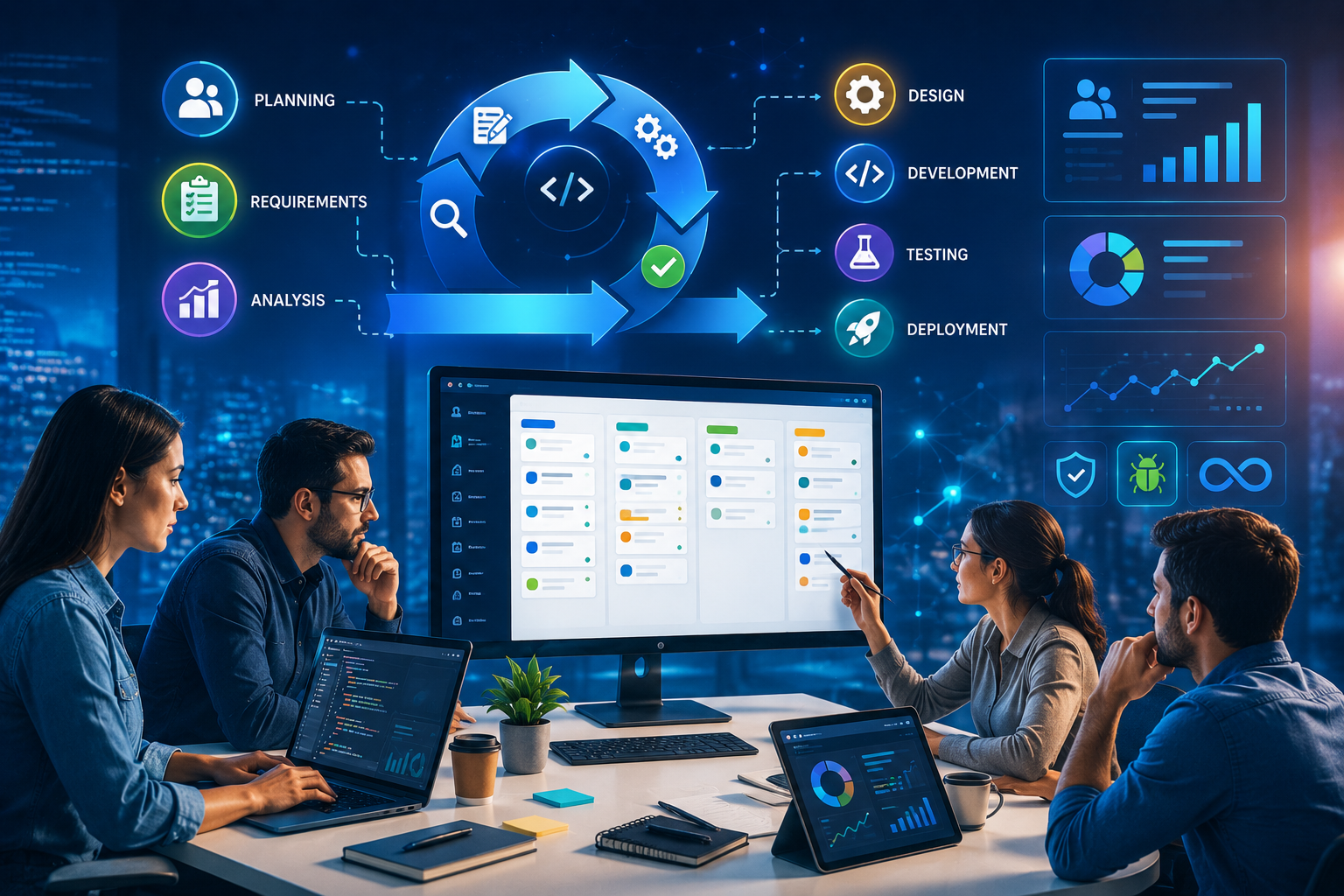
Software project management is the discipline of planning, executing, and tracking software development projects. It involves aligning business goals with engineering execution, managing timelines and budgets, allocating team resources (like developers and QA), and mitigating risks to deliver high-quality products.
In this article, we are discussing Software Project Management (SPM) topics that are useful to learn.
Key SPM ideas
- Goals and scope: Define what the software will do, deliverables, and acceptance criteria.
- Planning: Create schedules, estimate effort, assign resources, and set milestones.
- Execution and monitoring: Track progress, manage changes, monitor quality, and adjust plans as needed.
- Risk and quality management: Identify risks early, implement mitigations, and ensure software quality through reviews, testing, and process discipline.
- Stakeholder communication: Keep sponsors, customers, and team members informed about progress, issues, and decisions.
- Closure: Confirm acceptance, document lessons learned, and release or hand over the product.
Common SPM activities
- Requirements and scope management
- Project scheduling and estimation
- Resource allocation and team coordination
- Risk management and contingency planning
- Change control and configuration management
- Quality assurance and testing oversight
- Stakeholder engagement and reporting
- Deployment planning and post-project review
Where SPM sits
- SPM is a subset of software engineering and a specialization of general project management.
- It often employs frameworks and tools (e.g., Agile, Waterfall, or hybrid approaches) and uses metrics like velocity, burn-down charts, and earned value management to guide decisions.
Need for Software Project Management
Software is a non-physical product. Software Development is a new stream in business, and there is very little experience in building software products. Most of the software products are made to fit clients’ requirements. The most important thing is that basic technology changes and advances so frequently and rapidly that the experience of one product may not be applied to another one.
Such types of business and environmental constraints increase Risk in Software Development hence it is essential to manage software projects efficiently. It is necessary for an organization to deliver quality products, keep the cost within the client’s budget constraint, and deliver the project as per schedule. Hence, in order, software project management is necessary to incorporate user requirements along with budget and time constraints.
Types of Management in SPM
In Software Project Management (SPM), key management types include scope management, resource management, and risk management. SPM breaks down development lifecycles into targeted administrative areas to ensure software products meet requirements, deadlines, and budgets.
Core Management Areas in SPM
- 1. Scope Management – Scope Management is the process to restrict the negative features of conflict while increasing the positive features of conflict. The goal of conflict management is to improve learning and group results including efficacy or performance in an organizational setting. Properly managed conflict can enhance group results.
- 2. Risk Management – Risk management is the analysis and identification of risks that is followed by synchronized and economical implementation of resources to minimize, operate and control the possibility or effect of unfortunate events or to maximize the realization of opportunities. Overall Identifying, analyzing, and mitigating potential technical or scheduling roadblocks.
- 3. Resource Management – Resource Management: Allocating hardware, software tools, and team member hours efficiently.
- 4. Requirement Management – It is the process of analyzing, prioritizing, tracking, and documenting requirements and then supervising change and communicating to pertinent stakeholders. It is a continuous process during a project.
- 5. Time Management – Time Management: Scheduling tasks, setting milestones, and tracking project deadlines.
- 6. Change Management – Change Management is a systematic approach to dealing with the transition or transformation of an organization’s goals, processes, or technologies. The purpose of change management is to execute strategies for effecting change, controlling change, and helping people to adapt to change.
- 7. Quality Management – Quality Management: Enforcing continuous product testing and code reviews to reduce bugs.
- 8. Software Configuration Management – Software configuration management is the process of controlling and tracking changes in the software, part of the larger cross-disciplinary field of configuration management. Software Configuration Management includes revision control and the inauguration of baselines.
- 9. Release Management – Release Management is the task of planning, controlling, and scheduling the built-in deploying releases. Release management ensures that the organization delivers new and enhanced services required by the customer while protecting the integrity of existing services.
Notes:
- Different sources or practitioners might name or group these differently (some combine risk, quality, and change under broader “quality and governance” umbrellas, for example).
- At the project level, the most emphasized types are risk management, scope/requirements management, quality management, and stakeholder management, with configuration/change control playing a critical technical role. At the portfolio or program level, governance and strategic alignment become more prominent.
Aspects of Software Project Management
Software project management involves key areas like planning, resource allocation, and risk management to guide a team from start to finish. Here are the main aspects of software project management:
- Planning – The Software Project Manager lays out the complete project’s blueprint. The project plan will outline the scope, resources, setting timelines, milestones, dependencies, communication, testing, and maintenance steps. SPM actually does great here.
- Leading – A software project manager brings together and leads a team of engineers, strategists, programmers, designers, and data scientists. Leading a team necessitates exceptional communication, interpersonal, and leadership abilities. One can only hope to do this effectively if one sticks with the core SPM principles.
- Execution – SPM comes to the rescue here also as the person in charge of software projects will ensure that each stage of the project is completed successfully. measuring progress, monitoring to check how teams function, and generating status reports are all part of this process.
- Time Management – Abiding by a timeline is crucial to completing deliverables successfully. To assure progress in the face of blockages or changes, software project managers ought to be specialists in managing risk and emergency preparedness.
- Budget – Software Project Managers, like conventional project managers, are responsible for generating a project budget and adhering to it as closely as feasible, regulating spending, and reassigning funds as needed. SPM teaches us how to effectively manage the monetary aspect of projects to avoid running into a financial crunch later on in the project.
- Maintenance – Software project management emphasizes continuous product testing to find and repair defects early, tailor the end product to the needs of the client, and keep the project on track. The Software Project Manager ensures that the product is thoroughly tested, analyzed, and adjusted as needed. Another point in favor of SPM.
- Resource management: assigning people, tools, and technical resources.
- Risk management: identifying and reducing possible project problems.
- Quality assurance: making sure the software meets required standards.
- Communication: keeping the team and stakeholders informed.
- Monitoring and control: tracking progress and correcting deviations.
- Change management: handling scope or requirement changes properly.
- Closure: delivering the product, documenting lessons learned, and formal acceptance.
project management software VS Software Project management
Project management software is a tool used to plan, track, and manage projects. On the other hand, Software project management (SPM) is the discipline of managing software development projects, including people, process, scope, quality, risk, and delivery.
| Aspect | Project management software | Software project management |
| Meaning | A tool or application | A management practice/discipline |
| Purpose | Helps organize tasks, schedules, and collaboration | Guides how a software project is planned and controlled |
| Nature | Software product | Professional activity |
| Examples | Jira, Asana, Trello, Microsoft Project | Estimation, scheduling, risk control, QA, change management |
| Scope | Can be used for many kinds of projects | Focused specifically on software projects |
Drawbacks of Software Project Management
Numerous issues can develop if a Software project manager lacks the necessary expertise or knowledge. Software Project management has several drawbacks, including resource loss, scheduling difficulty, data protection concerns, and interpersonal conflicts between Developers/Engineers/Stakeholders.
- Costs are High – Consider spending money on various kinds of project management tools, software, & services if ones engage in Software Project Management strategies. These initiatives can be expensive and time-consuming to put in place. Because your team will be using them as well, they may require training. One may need to recruit subject-matter experts or specialists to assist with a project, depending on the circumstances. Stakeholders will frequently press for the inclusion of features that were not originally envisioned. All of these factors can quickly drive up a project’s cost.
- Complexity will be increased – Software Project management is a multi-stage, complex process. Unfortunately, some specialists might have a propensity to overcomplicate everything, which can lead to confusion among teams and lead to delays in project completion. Their expressions are very strong and specific in their ideas, resulting in a difficult work atmosphere. Projects having a larger scope are typically more arduous to complete, especially if there isn’t a dedicated team committed completely to the project. Members of cross-functional teams may lag far behind their daily tasks, adding to the overall complexity of the project being worked on.
- Overhead in Communication – Recruits enter your organization when we hire software project management personnel. This provides a steady flow of communication that may or may not match a company’s culture. As a result, it is advised that you maintain your crew as
small as feasible. The communication overhead tends to skyrocket when a team becomes large enough. When a large team is needed for a project, it’s critical to identify software project managers who can conduct effective communication with a variety of people. - Lack of Originality – Software Project managers can sometimes provide little or no space for creativity. Team leaders either place an excessive amount of emphasis on management processes or impose hard deadlines on their employees, requiring them to develop and operate code within stringent guidelines. This can stifle innovative thought and innovation that could be beneficial to the project. When it comes to Software project management, knowing when to encourage creativity and when to stick to the project plan is crucial. Without Software project management personnel, an organization can perhaps build and ship code more quickly.
However, employing a trained specialist to handle these areas, on the other hand, can open up new doors and help the organization achieve its objectives more
quickly and more thoroughly.
Why Choose Softxmind for Software Project Management
Choosing Softxmind for software project management ensures agile execution, custom workflow adaptation, and transparent collaboration. They align software development directly with business goals to maximize productivity and ROI.
Key Advantages
- Agile Methodologies: Adapts flexible, iterative project management approaches like Agile and Scrum to fit specific project needs.
- Workflow Customization: Builds tracking and management systems around exact business workflows rather than forcing rigid out-of-the-box limitations.
- Transparent Communication: Maintains close collaboration via regular updates, feedback loops, and aligned milestones.
- Vetted Expert Teams: Assembles tailored squads of experienced project managers, product managers, and developers.
Conclusion
Software Project Management (SPM) plays an important role in the success of software development. It requires project managers to have strong leadership, communication, and problem-solving skills. When project managers manage their projects effectively, they can guide their teams toward achieving business goals and delivering high-quality software products.
Frequently Asked Question About Software Project Management
What is meant by software project management?
A definition of software project management is straightforward: it is the discipline that turns software work into a controlled delivery process, aligning scope, timelines, costs, quality expectations, risks, and team responsibilities around one defined outcome.
Who is a software project manager?
Project managers in software organize software projects and can assign tasks to software engineering teams according to the specifications of a task. Software project managers use their leadership skills, technical knowledge and experience to direct their teams and ensure software meets client requirements.
What does proper software project management look like?
Proper software project management is a structured process defined by clear scope control, active risk management, and transparent team communication. It balances four core pillars: scope, time, cost, and quality to turn ideas into working products.
The Main Pillars and Planning
- Scope Definition: Setting exact project boundaries to prevent unmanaged changes (scope creep).
- Work Breakdown: Splitting large goals into small, manageable tasks and setting realistic timelines.
- Budget & Resource Control: Tracking labor costs, tools, and team workloads so no one burns out or overspends.
Execution and Daily Flow
- Clear Workflows: Using visual tracking systems like Kanban boards or sprint plans to show work in progress.
- Short Feedback Loops: Making decisions visible fast and adjusting plans when technical hurdles appear.
- Risk Mitigation: Spotting roadblocks early—like missing code dependencies or tight deadlines—before they stop the team.